
Keeping a house clean is not about motivation. It is about preventing mess from compounding.
Most homes do not get “dirty” all at once. They slowly drift. A few dishes sit overnight, laundry piles up, floors collect crumbs, bathrooms develop film, and the clutter you meant to put away becomes background noise. Then one day you look around and it feels like you need an entire weekend to fix it.
A clean home is usually the result of a simple system that runs in small pieces. When the system is light enough to repeat, the house stays close to baseline and cleaning stops feeling like a crisis.
Start with the part people miss: tidy first, then clean
Cleaning is hard when the house is not picked up.
If the counters are covered, the cleaner cannot wipe them. If the floor is full of shoes and toys, vacuuming turns into moving objects around. That is why the fastest path to “clean” is often a quick tidy.
Think of it as two layers:
- Tidy is returning items to their homes
- Cleaning is wiping, washing, and removing grime
If you do a little tidy every day, the cleaning part becomes shorter and easier.
Build a daily reset that takes 10 minutes
You do not need a perfect routine. You need a repeatable one.
A daily reset is the small set of actions that prevents the house from sliding.
A good reset usually includes:
- Clear the main surfaces where clutter gathers
- Do one small kitchen action, because the kitchen compounds faster than any other room
- Move one laundry step forward, even if it is only starting a load or folding five minutes
- Do one quick pickup pass: shoes, mail, toys, random items
Ten minutes does not solve everything, but it stops the build-up that creates stress.
Choose “zones” instead of trying to clean everything
Many people fail because they treat cleaning like an all-or-nothing event.
A simpler approach is to rotate focus by zone.
You keep the daily reset consistent, then you add one slightly longer task a few times per week.
A practical weekly rhythm looks like this:
- Early in the week, do bathrooms. Bathrooms get worse with moisture and time, so they benefit from predictable attention
- Midweek, do floors in the high-traffic areas. You do not need a full-house deep vacuum every time. Focus on where feet actually go
- Later in the week, do a kitchen detail pass: stove area, sink, and the sticky touch points like fridge handle and cabinet pulls
When you spread the work across the week, you never need a single “cleaning day”.
Make your home easier to keep clean
The house that stays clean is not the one with the most willpower. It is the one with fewer friction points.
A few changes that make a real difference:
- Give common items an obvious home. If putting something away requires three steps and a decision, it will not happen
- Keep simple supplies where you use them. A small bathroom kit, a kitchen cloth, a handheld vacuum in reach. Convenience wins
Reduce “micro-clutter” zones. Mail piles, entryway surfaces, the chair that collects clothes. If one spot always becomes a dumping ground, change the system instead of blaming yourself.
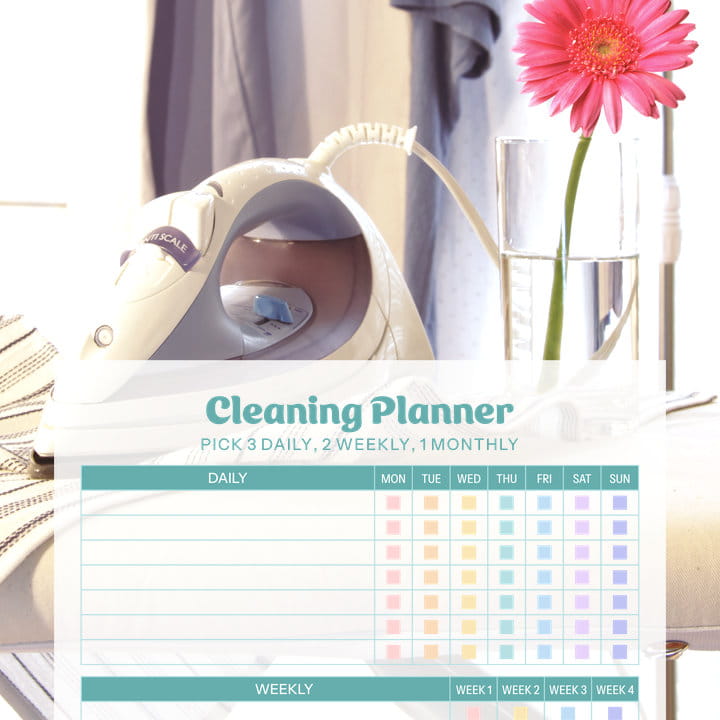
DWM Planner
Daily, weekly, monthly. Pick a few and repeat: download the DWM planner.
Use “one-touch” rules for the most common mess
Most mess is not dramatic. It is small items that never return to where they belong.
A one-touch rule means you handle something once instead of moving it five times.
Examples:
- When you walk in, shoes go to the shoe spot, not the middle of the floor
- Mail gets sorted immediately: trash, action, file
- Clothes go into a basket or onto a hook. Not onto a chair
If the one-touch rule feels too strict, do it only for one zone, like the entryway or kitchen counter. Even one zone changes the feel of the home.
Make cleaning a family system, not a solo job
If more than one person lives in the home, keeping it clean is a shared outcome.
The simplest approach is to assign small, repeatable responsibilities rather than big weekend chores.
One person handles trash and recycling.
One person does a quick floor pass.
Kids can do simple resets: shoes away, toys into a bin, wipe the table after meals.
When tasks are small and predictable, they actually happen.
What to do when you fall behind
Falling behind is normal. Life gets busy.
When the house feels overwhelming, do not start with deep cleaning. Start with a reset:
- Pick up obvious clutter into a basket
- Clear the kitchen sink
- Do one bathroom surface: sink and faucet
- Vacuum one high-traffic strip
That is enough to restore a sense of control. Then you can continue in small steps.
The bottom line
If you want a clean house without losing your weekends, stop chasing perfection.
Use a 10-minute daily reset, rotate zones through the week, and make your home easier to maintain with simple systems.
Cleaning is not one big event. It is a rhythm.
Printable Checklists
If you want a ready-to-use checklist for house cleaning and rotating deep-clean tasks, use our printables.
For updated routines and step-by-step guides, start with our main topics: Cleaning Routines & Schedules, Room-by-Room Cleaning, Seasonal & Deep Cleaning.
Quick answers
Explore Blog Archive for focused resets that make a real difference. Subscribe to get new seasonal guides when they’re ready.